Why Most Clothes Don’t Work — And What “Support” Actually Looks Like
If you’ve ever felt like your closet is full, but somehow nothing feels quite right when you get dressed, this is for you.
This isn’t about trends, body types, or buying better clothes.
It’s a quiet reset for how we think about why clothing works — or doesn’t — and why the discomfort so many women feel while getting dressed is rarely personal.
A Common Experience (And Some Relief)
Many women I work with care deeply about what they wear.
They’ve chosen pieces thoughtfully.
They’ve invested in quality.
They’ve tried to be intentional.
And yet, when they get dressed, something still feels off.
That discomfort often turns inward:
Maybe I don’t know how to dress.
Maybe my body just doesn’t work with clothes.
If that sounds familiar, here’s the most important thing to know first:
You’re not imagining it. And you’re not doing anything wrong.
Today isn’t about fixing anything.
It’s about understanding why this keeps happening — and why it isn’t personal.
Why Clothes “Don’t Work” (Even When They Look Fine)
When clothes don’t work, it’s rarely because of the body wearing them.
More often, it’s because of mismatch.
A piece can look completely fine on the hanger. There’s nothing obviously wrong with it. But once it’s on a body, the proportions don’t quite settle.
The eye keeps adjusting.
The wearer keeps adjusting.
Nothing is failing — it’s just not landing.
Often, when we shift just one element — proportion, structure, or balance — that unsettled feeling softens. Sometimes the difference is so small it’s easier to feel than to describe.
Structure isn’t good or bad.
Softness isn’t good or bad.
What matters is whether a garment meets the body halfway.
Sometimes structure asks the body to conform to it.
Sometimes softness offers no grounding at all.
Both can feel uncomfortable — not because they’re wrong, but because they’re mismatched.
And then there are trends.
Certain silhouettes circulate widely. They photograph beautifully. They work incredibly well on some bodies. But when they’re worn without context, they can feel demanding — as if they only work under very specific conditions.
When this happens repeatedly, it starts to feel personal.
But it isn’t.
Why Quality and Price Don’t Fix This
This is where many women feel the most confusion — and the most guilt.
Because if something is well-made… shouldn’t it work?
Not always.
A piece can be beautifully constructed. You can feel the quality immediately. And still, it can ask a lot from the body.
It may require constant awareness.
Adjustment.
A certain posture or way of moving.
When that demand is slightly reduced — not replaced, just adjusted — the experience often changes.
This isn’t about price.
And it isn’t about “better” or “worse.”
It’s about compatibility.
One piece creates effort.
Another creates ease.
Quality tells us how something is made.
It doesn’t tell us how it will feel once it’s lived in.
When we understand that, a lot of self-blame can fall away.
The Shift That Changes Everything: From “Should” to “Support”
There’s a quieter question that changes how getting dressed feels.
Instead of asking:
“Should I be wearing this?”
Try asking:
“Does this support me?”
Support shows up in subtle ways.
There’s less adjusting.
Less checking.
Less awareness of the clothes themselves.
The body isn’t performing for the garment.
The garment is working quietly in the background.
That calm usually comes from one small shift — not a full transformation.
Support feels like ease.
Ease in movement.
Ease in posture.
Ease in attention.
This doesn’t mean a look is boring.
It means it isn’t demanding.
This idea of support — rather than perfection — is the reference point we’ll keep returning to.
A Quiet Visual Example of Support
Sometimes support is easier to recognize visually than to explain.
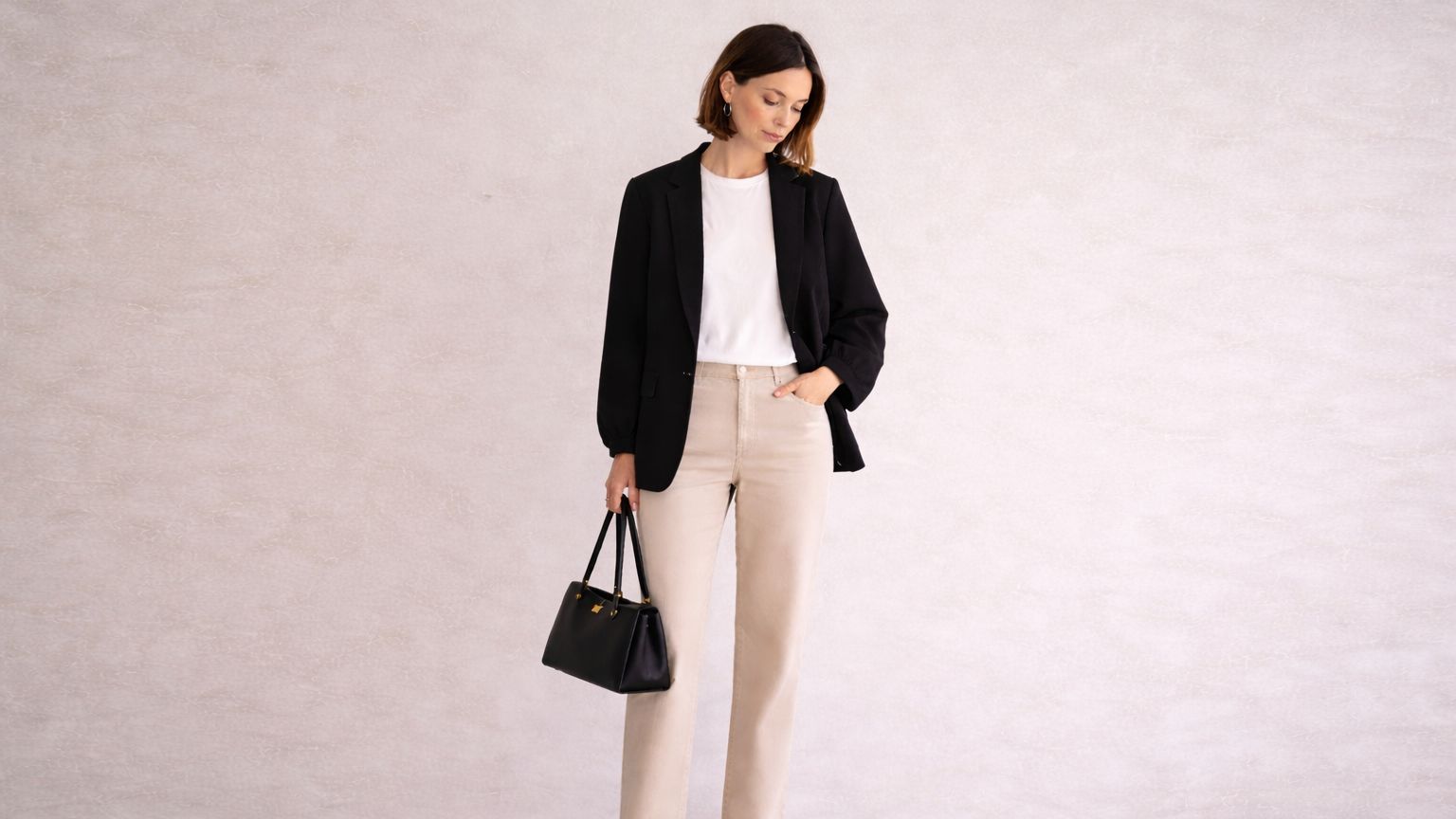
Below is a quiet example of a small adjustment — not to suggest what you should wear, but to show how ease can appear when something settles more naturally on the body.

In both versions, the outfit is essentially the same.
What changes isn’t the style — it’s how the body relates to it.
Often, the second version feels calmer to wear — not because it’s better, but because it asks a little less.
What to Begin Noticing (No Action Required)
Before anything changes, awareness changes.
You might start to notice:
-
how fabric behaves when you move — whether it flows with you or resists
-
where lengths land, and how that affects your sense of balance
-
how much structure a piece brings — and whether it feels grounding or constraining
There’s nothing to change yet.
This isn’t a checklist.
It’s not an evaluation.
Noticing these details helps you recognize which small shifts create ease — before replacing anything.
It’s simply noticing, without judgment.
What Comes Next
Learning to dress in a way that supports you isn’t about instinct or talent.
It’s about having a framework —
a framework that starts with experience, not rules.
Over the rest of the month, we’ll explore what “support” looks like in real pieces — starting with blazers, pants, and coats.
Not to tell you what to wear, but to help you understand why some pieces feel effortless, and others never quite do.
If this helped you see your closet differently, you’re not alone — and you’re exactly where this work begins.